

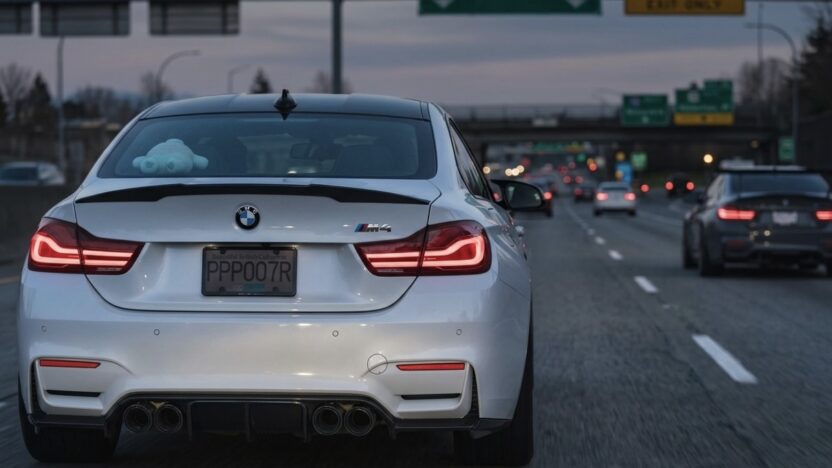
Yes, the tinted license plate covers are strictly illegal in Ontario and British Columbia. Even the ones that are perfectly “clear” can get you in trouble if they cause glare, yellow over time, or obscure the plate in any way.Yes, coloured license plate covers are 100% illegal in Ontario and British Columbia. Even completely “clear” ones can be problematic if they glare, yellow over time, or in any way obscure the plate.
Car guys buy these cheap covers online all the time. They look slick, they match the blacked-out trim on your car and, let’s be honest, they provide a little “privacy” from traffic cameras. But if you’ve recently slapped a tinted plate cover onto your ride in Ontario or British Columbia, you may want to grab a screwdriver and remove it immediately. That’s one of the best reasons drivers get hit with a frustrating “fix-it ticket” or a big fine.
We’ll look at exactly what the provincial motor vehicle acts say, why police are so concerned, and how to stay on the right side of the law.
The Rules in Ontario: Section 13
The law in Ontario is not ambiguous. Section 13(2) of the Highway Traffic Act (HTA) clearly states that “every number plate shall be kept free from dirt and obstruction”. The entire plate, including all numbers and validation markings, must be clearly legible at all times.
And, Section 13(3) is clearly directed at the “anti-camera” crowd. It requires that plates be not obscured by any device that would prevent them from being photographed by an automatic speed enforcement system or red light camera with reasonable accuracy. If a cop pulls you over for a smoked cover, it’s an easy pullover. Fines are generally around $110, but who wants to deal with the hassle of removing it on the side of the highway when you’re getting an aesthetic upgrade?
If you’re a new driver in Ontario who’s just getting into car culture, it’s important to learn these rules before you go modifying your vehicle. If you get pulled over for a modified plate, it can lead to further inspections of your vehicle. If you’re about to get your license, the best way to save yourself the headache is to know the rulebook inside and out. This Ontario G1 Practice Test app is a great way to practice the official rules.

Motorcycle riders aren’t immune either. Sportbike riders love “fender eliminator” kits and tucked, tinted plates. But if you’re studying for your M1, knowing about plate visibility is part of the core curriculum. Ontario M1 Knowledge Test Study Tool.
The Rules in British Columbia: Regulation 3.03
In BC the story is no different. According to Motor Vehicle Act Regulation 3.03, your license plate must be completely clear of any obstructions. The legislation points out that the numbers and letters must be clearly visible and legible at all times, and in particular capable of being correctly photographed by speed detection devices.
In BC, intersection cameras and toll systems rely so much on automated plate readers. A tinted cover interferes with the contrast needed for the optical character recognition (OCR) software to read the plate. If you get busted, expect a ticket of about $119 for improper display of a license plate.
CHECK OUT – Are Winter Tires Mandatory in Canada? The Complete Provincial Guide
For those currently studying for their BC licensing exams, learning the strictness of the MVA is a big deal. The official guide lays out what makes a vehicle legally roadworthy, and having a clear plate is high on the list. To make studying easier, there’s a highly rated ICBC Knowledge test app for Class 5 and 7

Similarly, BC motorcyclists dealing with tight tail sections and aftermarket plate mounts need to know the laws before their road test. You can brush up on all the specific motorcycle regulations using the ICBC Motorcycle knowledge test app.
Why Are They Illegal? The Real Reason
Retailers sell these covers under names like “Phantom” or “Stealth,” heavily implying they’ll save you from toll cameras (like the 407 in Ontario) or photo radar.
Automated License Plate Readers (ALPR) are affixed to police cruisers, toll gantries and red-light cameras. These cameras fire off an infrared flash to read the reflective paint on your license plate. Even some clear ones, reflective covers act like a mirror or a dark filter. Tinted, frosted and reflective covers do the same. They bounce the flash off or cut the reflection so the camera sees a blank rectangle.
The police know how this goes. A traffic cop does not think it looks cool seeing a tinted cover. They think that the driver is trying to mask his identity from the traffic police. It paints a huge target on your back and is an incredibly easy probable cause for a traffic stop. From there it can snowball into tickets for window tint, loud exhaust or any other modifications.
Keep your money. $20 on Amazon for a smoked plate cover is not worth the $110+ ticket or the roadside harassment. Make sure your plates are clean, visible and empty.
Sources
Ontario Highway Traffic Act, R.S.O. 1990, c. H.8, Section 13 – https://www.ontario.ca/laws/statute/90h08
British Columbia Motor Vehicle Act Regulations, B.C. Reg. 26/58, Section 3.03 – https://www.bclaws.gov.bc.ca/civix/document/id/complete/statreg/26_58_01
Vehicle Plate Visibility Violations, Pollock Paralegal – https://pollockparalegal.com/EN/traffic-tickets/minor-charges/vehicle-plate-visibility
Obscuring Your Licence Plates, SENSE BC – https://www.sense.bc.ca/o-plate.htm
[…] CHECK OUT – Are Tinted License Plate Covers Illegal in Ontario and British Columbia? […]